Sunrooms
How to Keep a Sunroom Cool in a Maryland Summer
October 20, 2026
To keep a sunroom cool in a Maryland summer, you combine the right roof, the right glass, good ventilation, shade, and, for rooms used on the hottest afternoons, a dedicated cooling system such as a ductless mini-split. No single fix does it all. A sunroom is a room built mostly of glass or vinyl panels, and anything built that way collects heat when the sun hits it. The good news is that most heat problems are predictable, and most of them are solved by decisions made before the room is ever built. This guide walks through why sunrooms get hot, which design choices matter most, and what you can do to cool a room you already own.
Why glass rooms gain heat
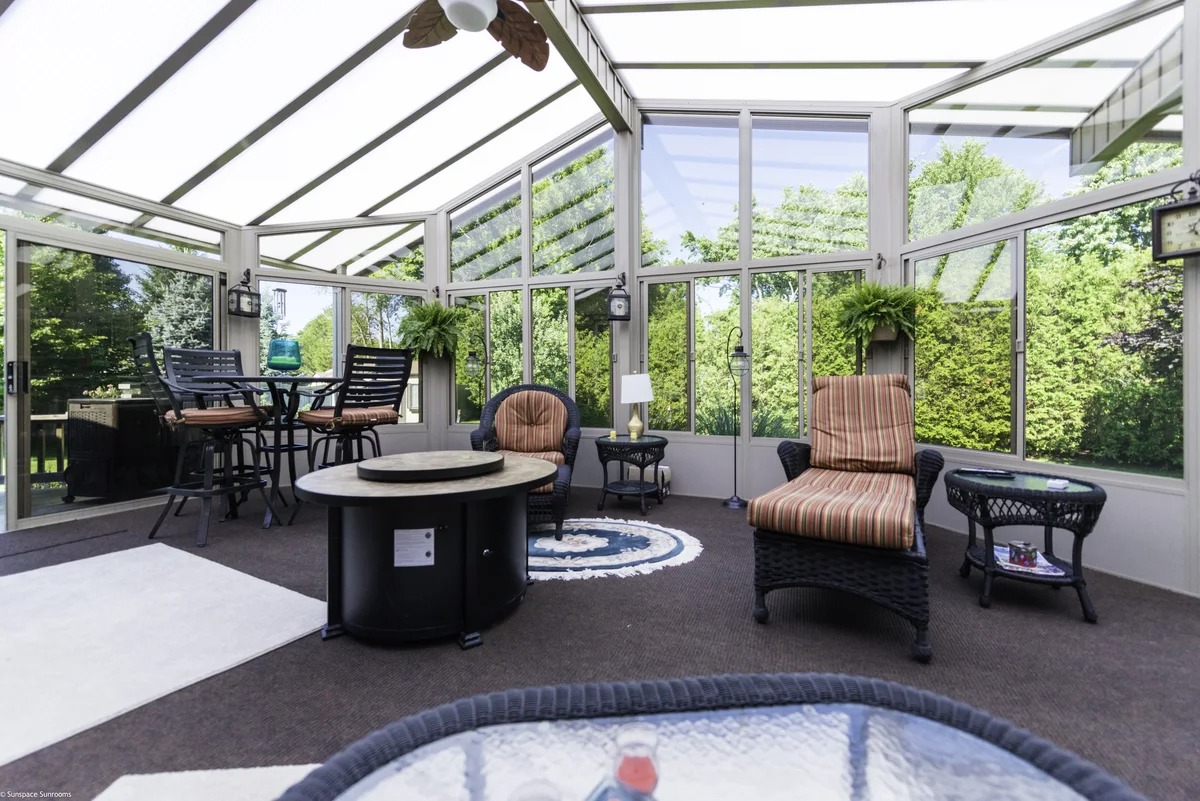
Sunlight passes through clear glass and clear vinyl easily. Once inside, that light lands on the floor, the furniture, and the walls, and those surfaces warm up. They then release heat back into the air, and that heat does not pass back out through the glazing nearly as easily as the light came in. The result is the familiar greenhouse effect: a closed room on a sunny day can climb well above the outdoor temperature.
Three other factors make it worse in a Maryland summer:
- Humidity. Our summers are humid, and humid air feels hotter than dry air at the same temperature. A sunroom that traps both heat and moisture can feel stuffy even when the thermometer reading seems reasonable.
- Roof exposure. The roof faces the sky for most of the day. A clear roof lets in the most light and therefore the most heat. A roof is often the single largest heat source in a sunroom.
- Still air. Heat builds fastest in a closed room with no air movement. Even a modest breeze across the room changes how it feels.
Orientation: which way the room faces
The direction your sunroom faces has a large effect on summer comfort. You usually cannot change which side of the house has room for an addition, but knowing what to expect helps you plan the rest of the design.
| Orientation | Summer sun exposure | What it means for cooling |
|---|---|---|
| South | Sun for much of the day, high overhead at midday | Strong heat gain through the roof; roof choice matters most |
| West | Low, intense afternoon and evening sun | Hardest to cool; low sun comes straight through the walls in late afternoon |
| East | Morning sun, shade in the afternoon | Usually comfortable; warms early and cools as the day goes on |
| North | Little direct sun | Easiest to keep cool; least solar heat gain |
West-facing rooms deserve special attention. Late-day sun sits low in the sky, so a roof overhang or a solid roof does little to block it. That light comes in sideways through the wall panels at the time of day many families want to use the room most. If your sunroom will face west or south, plan for an insulated roof, shading, and possibly a cooling system from the start.
East and north exposures are more forgiving. Many homeowners with an east-facing room find that ventilation and a ceiling fan are enough for most summer days.
Roof choice: the biggest single decision
On a full Sunspace sunroom, the roof is part of the system for your model, in a cathedral or studio pitch style, or the room installs under a roof you already have. On patio covers and roof systems, you choose from three roof panel options, and they behave very differently in summer. We cover each roof in more depth in our guide to sunroom roof options, but here is how they compare for heat.
Solid insulated roof
A solid insulated roof gives the best temperature control. It blocks direct overhead sun completely and slows heat moving through the roof. It also supports ceiling fans and light fixtures, which matters a great deal for cooling (more on fans below). For south and west exposures, this is usually the roof we recommend. The tradeoff is less overhead light. You can see how this roof is built on our insulated patio covers page.
Acrylic clear roof
An acrylic clear roof lets in about 90 percent of available light and is UV stable, so it will not yellow or break down in the sun. It is the brightest option and also lets in the most heat. A clear roof can work well on a north or east exposure, or for homeowners who mostly use the room in spring and fall, but on a south or west room in July it will be warm.
Hybrid roof
A hybrid roof mixes solid insulated panels with clear acrylic panels. You get some overhead light where you want it and solid coverage over the areas where you sit. For many families it is a sensible middle ground between brightness and summer comfort.
Low-E glass on the Model 400
If you want a sunroom you can use year-round, the Sunspace Model 400 is an insulated four-season room with thermal walls, thermal breaks in the frame, and Low-E argon glass. Low-E stands for low emissivity. It is a thin, nearly invisible coating on the glass that reflects much of the sun's heat while still letting visible light through. The argon gas between the panes slows heat transfer through the glass.
In summer, that combination helps keep heat out. In winter, it helps keep heat in. If summer comfort is a top priority and your room faces south or west, the Model 400 is worth a serious look. Learn more on our insulated sunrooms page or in our guide to four-season rooms in Maryland.
To be clear about the tradeoff: a Model 400 typically costs roughly $35,000 to $40,000 more than a Model 200 of the same size. For a 12x12 room, the typical range is $38,000 to $50,000 for a Model 200 and $75,000 to $90,000 for a Model 400. Not every family needs four-season construction. If you mostly use the room from spring through fall, a well-ventilated three-season room may serve you well.
Ventilation: let the heat out
The simplest way to cool a sunroom is to open it up. Moving air carries heat out and makes the room feel cooler right away.
The Sunspace Model 200 WeatherMaster, our most popular room, uses vertical 4-track vinyl windows that open up to 75 percent for ventilation. The windows still close tight against weather and bugs. On a breezy evening, opening the windows on opposite sides of the room creates cross ventilation that can clear built-up heat quickly. You can read more on our WeatherMaster sunrooms page.
The Model 300 uses double-roller windows that vent from both sides, which also helps air move across the room. And the Model 100 aluminum screen room offers maximum ventilation, essentially bug-free open air, which is the coolest option on a hot night but offers no protection from weather.
Ventilation tips that help in any sunroom:
- Open windows on opposite walls to create a cross breeze rather than opening one side only.
- Open high and low if your windows allow it. Hot air rises, so venting near the top lets it escape.
- Open the room early in the morning while the air is cooler, and close it during the hottest, most humid part of the afternoon if you are running a cooling system.
- Keep screens clean so air moves freely through them.
Ceiling fans
A ceiling fan does not lower the air temperature, but it makes people feel noticeably cooler by moving air across the skin. In a sunroom, a fan also keeps hot air from pooling near the ceiling.
Here is where roof choice matters again. On patio covers and roof systems, a solid insulated roof supports ceiling fans and lights. Whatever the project, if you know you want a fan, plan for it during design and plan the wiring before construction. We coordinate the electrical work as part of the project, so outlets, switches, fan boxes, and lighting are placed where you will actually use them.
Turn the fan off when nobody is in the room, since it cools people rather than the space itself.
Shading and blinds
Blocking sun before it enters the room is more effective than removing heat after it gets in. A few general approaches:
- Interior shades or blinds. These cut glare and reduce heat on the sunniest walls. Light-colored or reflective shades tend to work better than dark ones. They are especially useful on west walls in late afternoon.
- Exterior shade. Trees, a pergola, or other shade structures that block sun outside the room stop heat before it reaches the glass. A deciduous tree on the west side is a classic choice because it shades in summer and lets sun through in winter.
- Tinted vinyl. The WeatherMaster 4-track system, used in our walls-under porch enclosures, comes in 4 tint options. A tint reduces glare and some heat. Ask about tint choices during your on-site visit if heat or glare is a concern.
A dedicated cooling system
For a south or west room you plan to use on the hottest July and August afternoons, ventilation and fans may not be enough. That is when a dedicated cooling system makes sense, and the most common choice is a ductless mini-split.
A ductless mini-split has an outdoor unit and an indoor unit mounted on the wall, connected by a small line set. Many models both cool and heat, so one system can extend the room's usable season in both directions. It works independently from the rest of the house and can be turned on only when you are using the room.
One firm rule: we run sunrooms on their own heating and cooling and do not tie them into the home's existing HVAC. Your home's system was sized for the house as it was built. Adding a room with a large amount of glass can overload it, leave the sunroom uncomfortable, and make the rest of the house less comfortable too.
We coordinate the electrical for the cooling system as part of the build so the power is in place when the equipment goes in. Keep in mind that a cooling system works far better in an insulated room. A mini-split in a Model 400 has much less work to do than one fighting heat through single-glazed panels.
If you are wondering about the winter side of the same question, we cover heaters, insulation, and what to expect in cold weather in our article on whether you can heat a three-season room.
Humidity and condensation
Maryland heat comes with moisture, and a sunroom can trap it. High indoor humidity makes a warm room feel worse and can lead to condensation on glass and frames, especially on cool mornings after a humid night or when a cooling system chills the surfaces.
Ways to manage humidity:
- Ventilate. Opening the room lets humid air escape, particularly in the evening and early morning when outdoor air is drier and cooler.
- Use a cooling system that dehumidifies. Air conditioning removes moisture as it cools. A mini-split helps with humidity as well as temperature.
- Wipe condensation. Occasional condensation on cool glass is normal. Wipe it off so water does not sit on frames or sills. Persistent condensation between the panes of insulating glass is a different issue and should be looked at, since the Sunspace warranty covers insulating glass units for seal failure and fogging for 15 years.
Cooling a sunroom you already have
If you already own a sunroom that runs hot, start with the low-cost steps and work up:
- Add interior shades to the west and south walls.
- Ventilate in the morning and evening; create cross breezes.
- Add a ceiling fan if your roof can support one.
- Plant or build exterior shade on the sunniest side.
- Add a dedicated cooling system such as a ductless mini-split.
- For a large clear roof, consider whether a roof change is practical. We can look at what is possible for your room.
For older rooms, how well the room was built makes a difference too. Gaps, poor flashing, and failed seals let humid outdoor air in. Our guide to vinyl vs glass sunroom windows explains how each glazing type handles heat.
How we work
We are the authorized Sunspace dealer and the builder, with our own crews and no subcontracted installs. Every sunroom is permitted and inspected. Our process is simple:
- A free phone conversation. We talk about your space and how you want to use it, and we give you a price bracket on the first call.
- A one-hour on-site visit. We look at the orientation, the roof tie-in, and the existing structure, and we bring samples and colors.
- A to-the-penny written proposal. You get a final number for the full scope, including the roof, the glazing, and any electrical coordination for fans or a cooling system.
You can explore typical ranges with our sunroom pricing calculator; the final number comes in the written proposal. Let's talk about your outdoor space. Call us at 443-616-1459 or start a conversation.
Frequently asked questions
Why is my sunroom so hot in the summer?
Sunlight passes through glass and clear panels, warms the surfaces inside, and that heat does not escape as easily as the light came in. A clear roof, a south or west exposure, closed windows, and Maryland humidity all make it worse.
What is the best roof for keeping a sunroom cool?
For patio covers and roof systems, a solid insulated roof gives the best temperature control because it blocks overhead sun and slows heat through the roof, and it supports ceiling fans and lights. For a full sunroom, orientation, ventilation, and the model you choose matter as much as the roof style.
Can I connect my sunroom to my home's air conditioning?
We do not tie sunrooms into the home's existing HVAC. The home's system was sized for the house, and a glass room can overload it. We run sunrooms on their own heating and cooling, such as a ductless mini-split, and coordinate the electrical for it.
Does Low-E glass help in summer?
Yes. Low-E glass reflects much of the sun's heat while letting visible light through. The Sunspace Model 400 four-season room uses Low-E argon glass, which helps keep heat out in summer and in during winter.
How much ventilation does a WeatherMaster sunroom provide?
The Sunspace Model 200 WeatherMaster uses vertical 4-track vinyl windows that open up to 75 percent for ventilation, then close tight against weather and bugs.
How do I reduce condensation in my sunroom?
Ventilate the room, especially in the morning and evening, and use a cooling system that removes moisture. Wipe occasional condensation from glass and frames. Fogging between the panes of insulating glass is a seal issue and should be checked.