Sunrooms
Four-Season Rooms in Maryland: Insulation, Heating, and What They Cost
October 20, 2026
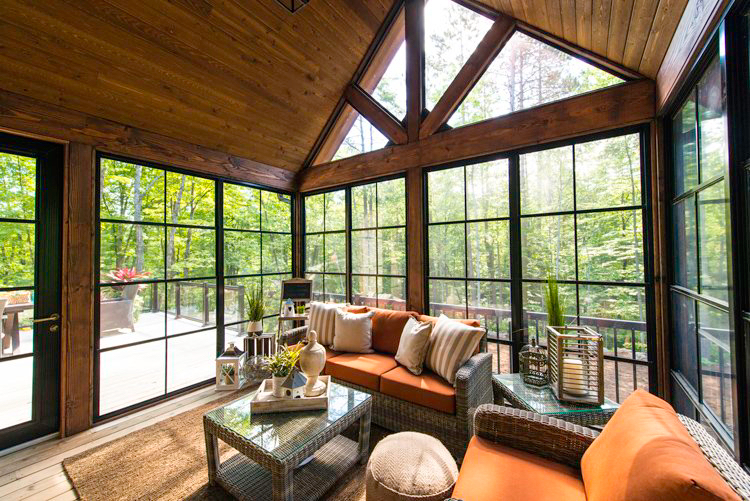
A four-season room is a sunroom built to be used every month of the year, including a Maryland January. It does that with insulated walls, insulated glass, thermal breaks in the frame, an optional insulated floor, and its own heating and cooling. In Maryland, a four-season room typically costs about $75,000 to $120,000 for the sizes most homeowners choose, which is roughly $35,000 to $40,000 more than a three-season room of the same size.
That premium is real money, so this guide is meant to help you decide whether a four-season room is the right fit for how you live, or whether a three-season room would serve you just as well. We build both, and we would rather you choose the right one than the expensive one.
What makes a room "four-season"?
The difference between a three-season room and a four-season room is not the shape or the size. It is how well the room holds heat in winter and keeps it out in summer. A three-season room is built to keep out wind, rain, and bugs. A four-season room is built to be insulated, conditioned living space.
The four-season room we build is the Sunspace Model 400. It includes:
- Thermal walls. Insulated wall panels instead of the lighter panels used in three-season rooms.
- Low-E argon glass. Insulated glass units with a low-emissivity coating and argon gas between the panes. The coating reflects heat back toward its source, which means winter heat stays in and summer heat stays out, while the argon slows heat moving through the glass.
- Thermal breaks. Insulating material built into the aluminum frame so cold does not travel straight through the metal into the room.
- An optional insulated floor. Floors lose a surprising amount of heat, especially when a room sits over a deck or open air rather than a slab.
Add a dedicated heating and cooling system, and you have a room that stays comfortable when it is 20 degrees outside or 95 and humid.
Four-season vs three-season room: side by side
| Three-season room | Four-season room | |
|---|---|---|
| Sunspace models | Model 200 WeatherMaster (vinyl windows) or Model 300 (glass) | Model 400 Insulated |
| Glass | Vinyl windows or single-glazed glass | Low-E argon insulated glass |
| Walls | Standard panels | Thermal walls |
| Frame | Aluminum | Aluminum with thermal breaks |
| Floor | Usually uninsulated | Optional insulated floor |
| Ventilation | Model 200 windows open up to 75 percent | Operable windows, but built to stay closed and conditioned |
| Comfortable use | Roughly early spring through late fall | Year round |
| Heating and cooling | Optional, for the shoulder months | Needed for winter and summer comfort |
| Typical cost (12' x 12' to 16' x 20') | About $38,000 to $85,000 | About $75,000 to $120,000 |
How much does a four-season room cost in Maryland?
These ranges come from the same pricing behind our online pricing calculator, so they match what you will see when you run your own numbers.
| Size | Model 400 four-season | Model 200 three-season | Difference |
|---|---|---|---|
| 12' x 12' (144 sq ft) | $75,000 to $90,000 | $38,000 to $50,000 | about $37,000 to $40,000 |
| 12' x 14' (168 sq ft) | $80,000 to $95,000 | $40,000 to $55,000 | about $40,000 |
| 14' x 16' (224 sq ft) | $90,000 to $105,000 | $52,000 to $65,000 | about $38,000 to $40,000 |
| 16' x 20' (320 sq ft) | $100,000 to $120,000 | $65,000 to $80,000 | about $35,000 to $40,000 |
Integrated railings add $2,500 to $5,000 when a room needs them. Your final, written proposal also reflects what the room sits on, the roof tie-in to your house, electrical, and the heating and cooling system. For the full picture of sunroom pricing across every type, see our sunroom cost guide for Maryland.
Why the premium is so consistent
Notice that the difference holds at roughly $35,000 to $40,000 regardless of size. That is because much of the extra cost is in the systems that make the room four-season, the insulated glass units, the thermal wall panels, and the thermally broken frame, and those scale with the amount of wall and glass rather than jumping with floor area. In practice, that means the four-season premium is a bigger share of the budget on a small room than on a large one. On a 12' x 12' room it nearly doubles the price. On a 16' x 20' room it adds about half.
Heating and cooling a four-season room
A four-season room runs on its own heating and cooling. We do not tie sunrooms into your home's existing HVAC, and for good reason.
- Your home's system was not sized for it. The furnace and air conditioner in most Maryland homes were sized for the house as built. Adding a room with a large amount of glass can push an existing system past what it was designed to handle, leaving both the house and the new room less comfortable.
- A sunroom heats and cools differently. Even with Low-E glass, a sunroom gains heat quickly on a sunny afternoon and gives it back faster on a cold night than a typical bedroom. A system dedicated to the room can respond to that on its own schedule.
- You only condition it when you use it. With its own controls, you can let the room drift on days you are not in it and bring it up to temperature when you are.
A dedicated system, such as a ductless mini-split, is a common way to handle this, and we coordinate the electrical it needs as part of the project. If you are considering a three-season room and wondering how far heat alone can take you, read can you heat a three-season room.
Designing for a Maryland climate
Maryland is a demanding place for a glass room. Winters bring stretches of freezing nights, snow, and ice. Summers are hot and humid. Spring and fall swing quickly between the two. A four-season room has to handle all of it, which is why the details matter.
Winter
Cold weather is where the four-season construction earns its cost. Insulated glass and thermal breaks keep the inside surfaces of the room warmer, which is what makes a room feel comfortable rather than drafty even when the air temperature is the same. The roof also has to carry snow load, and the tie-in to your house has to stay watertight through freeze and thaw cycles. We covered the winter side in detail in snow and ice damage to sunrooms and porches.
Summer
In summer, the challenge flips. Low-E glass reflects a significant share of the sun's heat. Roof choice matters too: a solid insulated roof keeps the overhead sun from baking the room in a way a clear roof cannot. Orientation matters too: a room facing south or west takes far more afternoon sun than one facing north or east, and we factor that into window and roof choices.
Humidity and condensation
Any time warm, moist indoor air meets a cold surface, condensation can form. Insulated glass and thermally broken frames reduce how cold those surfaces get, which reduces condensation. A dedicated heating and cooling system that also dehumidifies in summer helps keep the room dry and comfortable.
Is a four-season room worth it?
For some homeowners, absolutely. For others, a three-season room is the better use of the money. Here is how we help people think it through.
A four-season room is usually worth it if
- You want to use the room as everyday living space in January and February, not just on mild weekends.
- You plan to furnish it like an indoor room: upholstered furniture, a rug, electronics, a home office.
- You want a space for a specific year-round purpose, like a reading room, a plant room, or a place to watch the snow with your coffee.
- You intend to stay in the home long enough to get years of winter use out of the investment.
A three-season room is usually the better choice if
- You mainly want the room for spring, summer, and fall, and you are happy to close it up for the coldest weeks.
- You love the idea of opening the windows wide. The Model 200 opens up to 75 percent, which a four-season room is not designed to do.
- You would rather put the $35,000 to $40,000 difference toward a larger room, a new deck, or other projects.
- You are comfortable adding a heater for chilly days and getting extra months of use that way.
If you are still deciding between room types, our comparison of sunrooms, three-season rooms, and screen rooms and our guide to the difference between a sunroom and a three-season room go deeper.
Four-season room vs a traditional addition
Some homeowners compare a four-season room to a conventional framed addition. They are different projects with different strengths. A traditional addition can match your home's siding and roofline exactly and can be finished like any interior room, but it typically involves a longer, more disruptive build. A four-season sunroom is built from engineered, modular components on a proper foundation, so the build is more contained, and you get far more natural light than a framed room would ever give you. If light and views are why you want the space, a four-season sunroom is usually the better fit. If you want the room to be indistinguishable from the rest of the house, a framed addition may be. We are glad to talk through both honestly.
Warranty on a four-season room
The Sunspace Model 400 is covered by Sunspace's limited lifetime warranty. Among the key terms:
- Lifetime coverage on laminations and finishes, glass breakage in windows and doors, vinyl extruded components, and hardware and screen units, for as long as you own the sunroom.
- 15 years on insulating glass units against seal failure that causes permanent fogging between the panes.
Our installation work is backed by our own workmanship warranty, and we handle warranty registration for you. Our sunrooms page lists the full warranty terms and the fine print, and our warranty guide explains how our workmanship coverage works.
Permits for a four-season room
A four-season room is a permanent, conditioned addition to your home, so it needs a building permit and inspections, and some counties look more closely at insulated, heated space than at an unconditioned room. Requirements differ across Harford, Baltimore, Cecil, Anne Arundel, and Howard County, and many neighborhoods add HOA or architectural review. We pull the permit, prepare the paperwork, and meet the inspector as part of every project.
Getting a price for your four-season room
- Start with a phone call. We talk through how you want to use the room and give you a realistic price bracket on that first call.
- We visit your home for about an hour. We check orientation, what the room will sit on, and how it will tie into your house, and we bring samples so you can compare glass and finishes.
- You get a to-the-penny proposal. A written, final number for the full scope.
Want a ballpark first? Try our pricing calculator, or read more about the Model 400 insulated sunroom. Financing is available with terms up to 15 years and 0 percent options for qualified buyers; see our financing page. When you are ready, start a conversation or call 443-616-1459.
Frequently asked questions
What is a four-season room?
A four-season room is a sunroom built to be used year round. It has insulated walls, Low-E argon insulated glass, a thermally broken frame, an optional insulated floor, and its own heating and cooling, so it stays comfortable in winter and summer.
How much does a four-season room cost in Maryland?
A four-season room built with the Sunspace Model 400 typically costs about $75,000 to $120,000 for rooms from 12' x 12' to 16' x 20'. That is roughly $35,000 to $40,000 more than a three-season room of the same size.
Can a four-season room be connected to my home's HVAC?
We do not tie sunrooms into a home's existing system. Most home systems were not sized for an added glass room, and a sunroom heats and cools differently than the rest of the house. A dedicated system, such as a ductless mini-split, keeps both the house and the room comfortable.
What is the difference between a three-season and four-season room?
Insulation. A three-season room keeps out wind, rain, and bugs and is comfortable from roughly early spring through late fall. A four-season room adds insulated walls, insulated Low-E glass, thermal breaks, and heating and cooling so it can be used every month of the year.
Is a four-season room worth the extra cost?
It is worth it if you want to use the room as everyday living space through the winter and plan to stay in your home for years. If you mostly want the room for spring through fall, a three-season room is usually the better value.
Does a four-season room need a permit?
Yes. It is a permanent, conditioned addition and needs a building permit and inspections. We handle the permit and inspections as part of the project.