Comparison Guides
Sunroom vs Three-Season Room vs Screen Room: Which Is Right for Your Maryland Home?
June 18, 2026

A screen room keeps bugs out while staying open to the air, a three-season room adds real windows so you can use it comfortably from spring through fall, and a four-season sunroom is an insulated room you can heat and cool every day of the year. Which one is right for your Maryland home comes down to when you want to use the space, how much weather protection you need, and what you want to spend. These terms get used interchangeably, and they should not be. They are different products with different price tags and different jobs. Below we define each term, map each room to the Sunspace model we install, compare them side by side, and walk through how to choose.
We are an authorized Sunspace dealer and the builder, so the people who help you pick a model are the same crew that pours the footings, ties in the roof, and installs the enclosure. That gives us a practical view of what each room does well and where each one falls short.
The terms, defined
Before comparing anything, it helps to know what people mean when they use each word. Contractors, manufacturers, and real estate listings do not always use them the same way.
- Sunroom: the umbrella term for any windowed room attached to a house. Many people use "sunroom" to mean only the fully insulated version. We use it for the whole family of rooms and say "four-season" when we mean insulated.
- Screen room: a roof with screen walls. Open air, no glass or vinyl. In the Sunspace line this is the Model 100.
- Three-season room: a roof with operable windows (vinyl or single-glazed glass) that close against rain, wind, and bugs. Not insulated. In the Sunspace line this is the Model 200 WeatherMaster or the Model 300.
- Four-season room: an insulated room with thermal walls, Low-E argon glass, and thermal breaks in the frame, heated and cooled for year-round use. Also called an insulated sunroom or all-season room. In the Sunspace line this is the Model 400.
- Porch enclosure (walls-under system): no new roof. Enclosure panels are installed under an existing porch roof or patio cover to turn it into a screened or windowed room.
- Patio cover: a roof only, with no walls. It is often the first phase of a room that gets enclosed later.
Side-by-side comparison
| Feature | Screen room | Three-season room | Four-season room | Porch enclosure |
|---|---|---|---|---|
| What it is | Roof and screen walls, open to the breeze | Roof and operable windows, not insulated | Insulated room built like an addition | Screen, vinyl, or glass walls under an existing roof |
| Sunspace model | Model 100 | Model 200 WeatherMaster (vinyl) or Model 300 (glass) | Model 400 | WeatherMaster 4-track, WeatherMaster Plus bi-fold, or full glass |
| Glazing | Screens only | Vertical 4-track vinyl windows (200) or single-glazed glass (300) | Low-E argon insulated glass with thermal walls | Vinyl or glass, depending on the system |
| Seasons of comfortable use | Late spring through early fall | Spring through fall; colder days need a heater | Year-round | Spring through fall |
| Ventilation | Maximum, all walls open to air | Model 200 opens up to 75 percent; Model 300 double-roller windows vent from both sides | Operable windows, but designed to stay closed and conditioned | WeatherMaster opens up to 75 percent; bi-fold opens flexibly |
| Heating and cooling | None | Not designed for it; a heater helps on cold days | Its own system, such as a ductless mini-split | Not designed for it |
| Typical price range (12x12 to 16x20) | $12,000 to $35,000 | Model 200: $38,000 to $80,000; Model 300: $42,000 to $85,000 | $75,000 to $120,000 | $22,000 to $68,000 |
| Best for | Bug-free summer evenings on a budget | Most homeowners who want a bright, protected room most of the year | A home office, family room, or daily space in January | Homes that already have a covered porch or roof |
These are typical ranges from our sunroom pricing calculator. Integrated railings add $2,500 to $5,000. Size, site conditions, and options move the number, and the final figure comes in our written proposal. For a size-by-size breakdown of every model, see our Maryland sunroom cost guide.
Screen rooms (Sunspace Model 100)
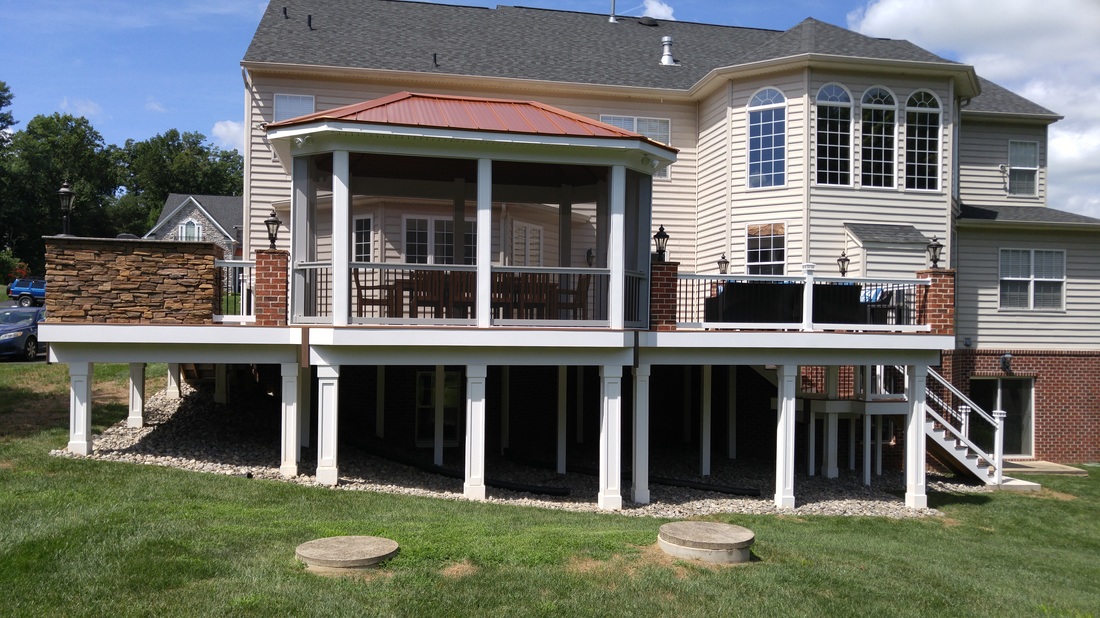
A Model 100 is an aluminum screen room: a solid roof overhead and screen walls on every open side. It is the most affordable way to turn a deck or patio into bug-free outdoor space, and it gives you the most airflow of any room in this guide.
That airflow matters in Maryland. Our summers are hot and humid, and mosquito season can be relentless, especially near the Chesapeake Bay, tidal creeks, and anywhere water stands after a storm. A screen room lets you eat dinner outside in July without fighting bugs, and the open walls catch every breeze without running an air conditioner.
The tradeoffs are just as real:
- Rain and wind come through. The roof keeps you dry in a straight-down shower, but wind-driven rain blows through the screens and a gusty day is still a gusty day.
- The season is short. Once fall nights turn cold, a screen room is as cold as the yard around it. There is no practical way to heat an open-air room.
- Little privacy. Screens offer almost no visual screening from neighbors or the street.
- Outdoor furniture only. Plan on weather-resistant furniture and somewhere to store cushions in the off season.
Upkeep is simple: check the screens each year for tears, clean them a couple of times a season, and keep debris off the roof and out of the gutters. Learn more on our screen room page.
Three-season rooms (Sunspace Model 200 and Model 300)
A three-season room steps up from screens to real windows. Close them and you shut out bugs, rain, wind, and the yellow film of spring pollen. Open them and you get a breeze. It feels much more like a finished room than a screen room does, so it works for more than summer dinners: morning coffee in April, a reading spot, a hobby or workout room, or a place to host friends in October. Indoor-style furniture is a realistic option, and we coordinate the electrical for lights, ceiling fans, and outlets.
Model 200 WeatherMaster (vinyl)
The Model 200 WeatherMaster is our most popular room. It uses vertical 4-track vinyl windows that open up to 75 percent for ventilation and close tight against weather and bugs. On a warm day you can stack the panels open and get close to a screen room feel. On a raw spring day you close them and stay dry. Visit our WeatherMaster sunroom page for details on the window system.
We want to be straight about one thing: vinyl is not glass. It is clear and flexible, but it does not look exactly like glass, and it has to be cleaned gently, with no harsh cleaners, detergents, or bleach. Clean it the right way and Sunspace covers vinyl glazed windows for 10 years against fading and cracking.
Model 300 (glass)
The Model 300 is a bright glass three-season room on an extruded aluminum frame. It uses single-glazed glass with double-roller windows that vent from both sides. You get the clarity and traditional look of glass. Because the glass is a single layer, it is not insulated, which is what keeps it a three-season room. For a deeper look at the two materials, read sunroom windows: vinyl vs glass.
What a three-season room will not do
Neither model is built to be heated through a Maryland winter. On a sunny day in March or November the room warms up nicely. On a cold, gray January day it will be chilly unless you run a heater, and without insulation the heat does not stay long. In peak summer heat, even a Model 200 opened to 75 percent will not move as much air as an all-screen room. If either of those limits is a deal breaker, keep reading. Our guide to three-season rooms in Maryland covers how homeowners actually use them through the year.
Four-season rooms (Sunspace Model 400)
A Model 400 is built like an addition. It has thermal walls, Low-E argon glass, thermal breaks in the frame that slow heat moving through the aluminum, and an optional insulated floor. It is the room you can sit in with coffee on a January morning or use as a home office every weekday.
A four-season room runs on its own heating and cooling, typically a ductless mini-split. We do not tie sunrooms into your home's existing HVAC; that system was sized for the house you have now, not for a new room full of windows. We coordinate the electrical for the new unit as part of the build.
The cost reflects the construction. A Model 400 typically runs roughly $35,000 to $40,000 more than a Model 200 of the same size. For many families that difference is worth it because the room gets used every day instead of most days. Our four-season room guide covers insulation, heating and cooling, and cost in detail.
Porch enclosures under an existing roof
If you already have a covered porch or a roof over your deck, you may not need a whole new room. A walls-under system goes beneath the existing roof and turns the space into an enclosed room. Sunspace offers three versions:
- WeatherMaster 4-track: the same vinyl window system as the Model 200, opening up to 75 percent, with 4 tint options.
- WeatherMaster Plus bi-fold: panels fold aside for unobstructed views and flexible opening.
- Full glass system: a traditional look and the clarity of glass.
Because the roof is already there, a porch enclosure typically costs less than a complete room of the same size. We check the existing roof and framing during the site visit to make sure it is a sound base for the enclosure. See our walls-under systems page for more.
How Maryland weather and site details affect the choice
Maryland gives you all four seasons: humid summers in the 80s and 90s, a long and pleasant spring and fall, freezing winters with occasional snow, and thunderstorms in summer. A few site details change how any of these rooms performs:
- Orientation: a south-facing room catches the most sun, which is great in spring and fall but can overheat in summer. A north-facing room stays cooler in summer and gets less warmth in winter. An east-facing room gets morning light.
- Roof type: a sunroom can have a cathedral or studio pitch roof, or install under an existing roof. For roof-only patio covers, solid insulated, clear acrylic, and hybrid panels trade temperature control against light.
- Snow and freeze/thaw: the roof structure and footings have to be built for our snow loads and frost, which is part of why the foundation work matters as much as the room itself.
- Permits and reviews: every sunroom we build is permitted and inspected. We pull the permit, prepare the paperwork, and meet the inspector. Homes near tidal water may fall in the Chesapeake Critical Area, and HOA or Columbia Association review in Howard County can apply. We handle that review when it applies.
Which should you choose?
Start with three questions. When do you want to use the room? How will you use it? And what is already there: a bare patio, a deck, or a covered porch? Your answers usually point straight to one of these options.
Choose a screen room if you:
- Mainly want relief from bugs during warm months
- Love the feeling of being outdoors in a breeze
- Have a tighter budget and plenty of indoor living space already
- Have a lot that catches a good summer breeze
Choose a three-season room if you:
- Want to use the space from spring through fall without worrying about rain, wind, or pollen
- Want a room for coffee, dining, hobbies, or entertaining most of the year
- Would like more privacy than screens offer
- Are fine stepping back, or running a heater, during the coldest weeks
Choose a four-season room if you:
- Want to use the room every day, including January
- Need a home office, family room, or TV room that stays comfortable
- Prefer the look and feel of a true addition
Choose a porch enclosure if you:
- Already have a covered porch or roof that is in good shape
- Want three-season comfort for less than a complete new room
The upgrade path: start with screens, add windows later
If your budget points to a screen room but you think you will want more someday, the Model 100 has a built-in path forward. A Sunspace screen room can be upgraded later with vinyl windows, which turns it into a three-season room without tearing anything down. Many homeowners like that phased approach: enjoy bug-free summers now, close it in when the time is right.
The path has a limit. Insulation, thermal breaks, and Low-E argon glass are built into a Model 400 from the start, so a three-season room does not practically become a four-season room later. If you already know you want year-round use, it usually costs less to build the Model 400 once than to build twice.
You can explore every model on our sunrooms page.
How we help you decide
Every room we build follows the same three steps, and the first one costs you nothing:
- A phone conversation. Tell us how you want to use the space and what you have now. We give you a price bracket on that first call.
- A one-hour site visit. We look at your deck, patio, or porch, bring samples and colors, and talk through the models that fit.
- A to-the-penny written proposal. You get a final number for the full scope, including permits, foundation, structure, enclosure, electrical coordination, and finish work.
We have been building for more than 30 years with our own crews, and we serve Harford, Baltimore, Cecil, Anne Arundel, and Howard County from our home base in Fallston. Our work carries a 2-year workmanship warranty, and we register your Sunspace manufacturer warranties for you. Let's talk about your outdoor space: call 443-616-1459 or start a conversation.
Frequently asked questions
Is a three-season room the same as a sunroom?
A three-season room is one type of sunroom. "Sunroom" is the umbrella term for any windowed room attached to a house. A three-season room has windows but no insulation, while a four-season sunroom is insulated and heated and cooled for year-round use.
Can I use a three-season room in winter?
On sunny, milder winter days, yes, especially with a portable heater. On cold, gray days it will be chilly because the walls and glazing are not insulated. If you want to use the room comfortably every day in January, a four-season room is the better fit.
How much more does a four-season room cost than a three-season room?
A Model 400 four-season room typically costs roughly $35,000 to $40,000 more than a Model 200 three-season room of the same size. The final number for your project comes in our written proposal.
Can a screen room be turned into a three-season room later?
Yes. A Sunspace Model 100 screen room can be upgraded later with vinyl windows, which turns it into a three-season room without starting over.
Does a sunroom connect to my home's heating and cooling?
No. We do not tie sunrooms into the home's existing HVAC. A four-season room gets its own heating and cooling, such as a ductless mini-split, and we coordinate the electrical for it.
Do I need a permit for a screen room or sunroom in Maryland?
Every sunroom and screen room we build is permitted and inspected. We pull the permit, prepare the paperwork, meet the inspector, and handle HOA or architectural review when it applies.